

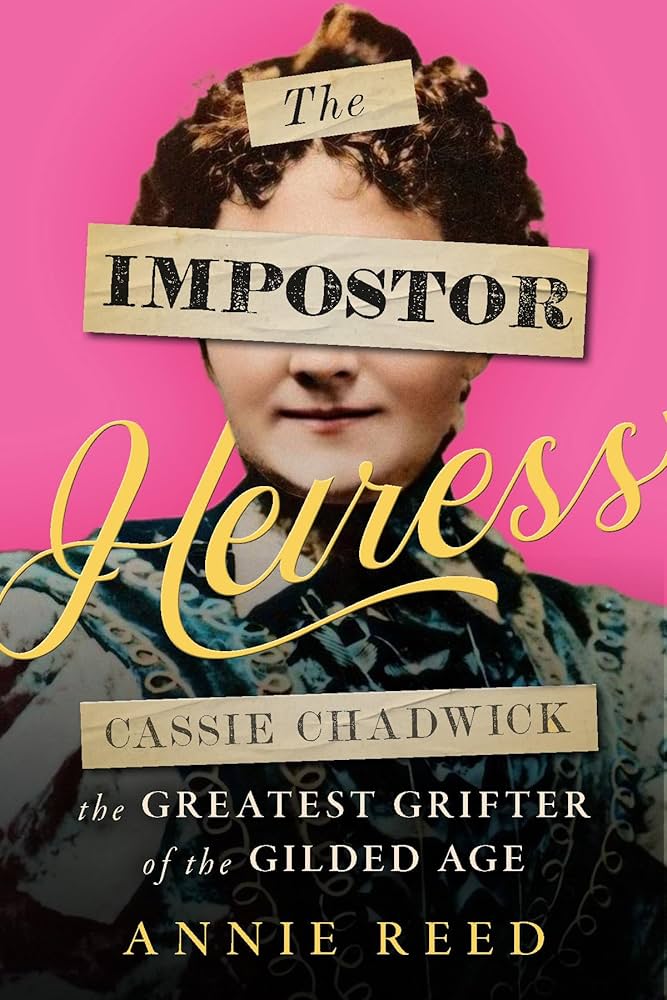
Title: The Impostor Heiress: Cassie Chadwick, The Greatest Grifter of the Gilded Age
Author: Annie Reed
Publisher: Diversion Books
Copyright: June 11, 2024
ISBN: 978-1635769821
ASIN: B0CN7N8R83
Format: E-Book
Genres: True Crime, Historical Nonfiction, Hoaxes & Deceptions, Women in History, U.S. State & Local History
Summary
Paroled felon. Rich doctor’s wife. Famous clairvoyant. Cassie Chadwick, one of history’s most successful con artists, was a master of reinvention. In the dusk of the Gilded Age, she swept from town to town, assuming fresh identities to swindle a fortune so large that it rivaled the robber barons of the time.
Then came arguably the greatest con in American history. Using forged documents and her peerless wits, Cassie convinced prominent men from Cleveland to New York City that she was the illegitimate daughter of the world’s wealthiest man—Andrew Carnegie.
Businessmen loaned her hundreds of thousands of dollars at a time; the ensuing crash shattered banks and bankers alike. Her sensational trial made her a household name. The newspapers called her the “Queen of Swindlers,” the “Duchess of Diamonds,” the “High Priestess of Fraudulent Finance.”
Interspersing Cassie’s crimes with stories of an unsuspecting Andrew Carnegie, author Annie Reed spins an enthralling, page-turning tale of true crime. Long before Anna Delvey captivated national attention, there was Cassie Chadwick—the mother of the American con.


From the Gold Room at Marble House in Newport, Rhode Island. Source: Billy Wilson via Flickr. No changes were made.
Upper-Class White Women in the Gilded Age
I was once standing in Mark Twain’s Hartford mansion. It was an imposing building that Twain poured a great deal of money into. While there, I learned about the true meaning behind “the gilded age.” It was a term that he coined as representing the character of the epoch. The docent gestured to a certain gilded aspect of the interior of the house. She pointed out that Twain was speaking of the gilded exterior but the morally rotten interior beneath it.
The Cult of True Womanhood

This drawing from 1857 shows two Victorian women criticizing the fashions from the Regency era. Source: Churchh/Harper’s Weekly

To some extent, all women of the Gilded Age faced limitations. Since The Impostor Heiress deals a lot with the opulent world that Cassie Chadwick claimed to belong to, I will be focusing on middle to upper-class white women. These are the sort of women that Cassie would have interacted with. It was a highly traditional and conservative world where etiquette was everything. The wealthy wife was the queen of her domain.
In the nineteenth century, there was a movement called “the Cult of True Womanhood” or “the Cult of Female Domesticity.” The middle to upper-class white woman (or “True Woman”) was seen as an angel in the home who ministered to her world-weary husband. The qualities of purity, piety, domesticity, and submissiveness were highly prized. She knew that the home was her proper place, and she had no desire to interfere in the public sphere. After all, it should not concern her. She was delicate and weak, acknowledging her dependence on her husband who was her superior.
The Society Matron
In addition to this, no “true woman” was ever expected to draw attention to herself. According to Cecelia Tichi: “During the Gilded Age, it was said that a lady’s name should be publicized only thrice in her lifetime: at her birth, her marriage, and her death.” To the middle to upper-class white woman of the Gilded Age, being a homemaker and society hostess was her vocation. The options for such a woman was limited. When she was unmarried, she was under the guardianship of her father and, after she married, at the mercy of her husband.1
Nan Johnson writes about how American society in the postbellum period idolized “the icon of the American woman as an angel of the hearth” who was “a quiet woman.” She was unlike her noisy counterparts who were “the enthusiastic woman, the talkative woman, the brilliant woman, and the babbling woman.” Johnson further explains that the middle to upper-class woman of the postbellum period was encouraged to be firmly anchored in her own gender identity. Much like a child, this “true woman” was seen and not heard.2
This is exactly the kind of world that Cassie Chadwick, the famous con artist, lived in. She utilized society’s expectations of a middle to upper-class white woman to her advantage. She weaponized her femininity to play the weak woman who needed a man’s strength. She often played this card to appear delicate and confused in front of her victims.
On a final note, the idea of a “true woman” is problematic. This applied to women who fit into a certain mold. It completely marginalizes the other women who existed in American society: women of color, immigrant women, etc. It implied that the women did not quite fit the mold were not true women.
Review

Portrait of Cassie Chadwick, 1904. Source: Public Archives/ValliNagy

The Impostor Heiress tells the compelling story of the notorious Cassie Chadwick, a con artist from America’s Gilded Age. Born into humble origins in Canada as Elizabeth Bigley, she realized early on how she could scam others for her own financial gain. This was quite a feat considering the impediments that women in the nineteenth century had to deal with—they couldn’t vote and, once married, had no control over their own finances.
While Cassie’s name isn’t universally recognized nowadays, she was fairly well known in the United States of the late-nineteenth and early-twentieth centuries. Those who belonged to high society knew that her reputation often preceded her. She was the “Mrs. Chadwick,” a respectable lady, the wife of a wealthy doctor, a celebrated society hostess, and the rumored illegitimate daughter of Andrew Carnegie, the wealthiest man in the entire world. To some people, she was so respectable that no one should ever dare question her conduct.
Even though Cassie wasn’t a classically attractive woman, she possessed enough cleverness and charisma to draw her male victims into her web. She used the charisma to charm various men and cleverness to weave elaborate deceptions that were just believable enough. In addition to that, she used her femininity as a weapon—playing the part of the vulnerable female in need of help. With this winning combination and her claim to be Carnegie’s illegitimate daughter, how could she not amass a grand fortune from her victims?
In time, Cassie’s victims began to suspect that something wasn’t quite right. She would always request a loan, declaring that Andrew Carnegie would repay every last cent. When no money was forthcoming, that was when the lawsuits began. Eventually, she became entangled in her own lies. When Carnegie was asked if he had an illegitimate daughter, he denied ever fathering Cassie.

A portrait of Andrew Carnegie by Billy Hathorn, 1905. Source: Peterforsyth

The Impostor Heiress, Annie Reed’s debut book, is an engrossing nonfiction work. The author earned a law degree from Notre Dame and a history degree from the University of Illinois at Urbana-Champaign. This book is masterfully written and expertly researched. Reed juxtaposes Cassie’s story alongside anecdotes from Carnegie’s life. This creates a great flow that keeps the story moving forward at a steady pace. Not only is everything beautifully written, but in the pages of this book, the bygone world of the Gilded Age is brought to life. Many of the real life figures, including Cassie herself, are larger than life.
I read this book fairly quickly. This is a book I will be recommending to true crime fans for years to come. Cassie is such a psychologically complex character who did what many women would never have dared to do. She knew how to weave these elaborate lies and use her femininity against wealthy and powerful men. I was simply bewitched by Reed’s elegant prose and by the character of Chadwick herself.
Reed presents an extensive bibliography containing her research at the end of the book. She includes anecdotes from different sources in the “Notes” section, which is an interesting addition. My only critique of this book (if you can call it that) is that I wish that Reed wrote more about her experience writing this book. There is a brief “Dear Reader” section at the start of the book that sheds some light on how she discovered Cassie Chadwick. Needless to say, I fully recommend this book!
I graciously received this advanced reading copy (ARC) from Diversion Books through Netgalley!

Rating

Memorable Quote
She [Cassie Chadwick] wanted jewels on everything. And not only in usual places, glistening from around her neck, fingers, and wrists. She bought a chatelaine bag covered with diamonds, rubies, emeralds, and sapphires. She bought a set of silver plates and saucers studded with rubies. She bought a dog collar made of pearls. She had diamonds mounted in a comb. At times, she bought gems by the tray; loose, beautiful diamonds, like dewdrops in the sun.
Annie Reed
If you like this, check this out…

Source: TV Insider
Julian Fellowes’s The Gilded Age made its debut in 2022. If you are interested in learning more about the Gilded Age in general, definitely give this show a watch!
Research
- Tichi, Cecelia. What Would Mrs. Astor Do?: The Essential Guide to the Manners and Mores of the Gilded Age. Washington Mews, 2018.
- Johnson, Nan. Gender and Rhetorical Space in American Life, 1866-1910. Southern Illinois University Press, 2002.